Bid support
Pre-bid engineering for EPC tenders

In short
In an EPC / design-build tender, you own the design — so before you can price a credible bid you must do real engineering: study the scope, develop a concept design, take off quantities, build the BoQ and rates, and write the methodology and technical proposal. That work is pre-bid engineering, and it decides three things:
- Whether you qualify — a compliant, well-documented technical proposal clears the technical stage.
- Whether you're competitive — accurate quantities and rate analysis give a sharp, defensible price.
- Whether you make money — scope gaps and quantity errors caught now are margin saved later.
An item-rate tender hands you a ready BoQ and asks only for your rates. An EPC (Engineering, Procurement, Construction) or design-build tender does the opposite — it gives you a scope and outcomes and expects you to engineer the solution, quantify it and price it. That shifts the hard work to the weeks before submission. Get the pre-bid engineering right and you bid with confidence; get it wrong and you either lose on price or win a loss-making job.
Why pre-bid engineering decides the bid
Qualify
A complete, compliant technical proposal (design basis, drawings, methodology, deviations) clears the technical evaluation.
Compete
Quantities taken off from a real concept design — not guessed — let you price tight without exposure.
Protect margin
Scope ambiguities, geotech risk and missing items found pre-bid become priced contingencies, not losses.
What strong pre-bid engineering covers
1
Tender & risk study
Decode the scope, specs, eligibility, GCC/SCC and ATC; build a risk register and bid/no-bid view.
2
Site & data review
Survey, geotech, hydrology, ROW and utility data; ground-truth the assumptions behind the price.
3
Concept design & DBR
Enough engineering — alignment, layouts, structural/hydraulic concepts — and a Design Basis Report to quantify and comply.
4
Quantity take-off
Quantities derived from the concept design, division by division (civil, structural, MEP).
5
BoQ & rate analysis
Build the priced BoQ with rate analysis from SOR, market rates, material + labour + plant + overheads.
6
Pricing & cash flow
Bid build-up, escalation, financing and cash-flow view so the headline price is also a profitable one.
7
Methodology & schedule
Construction methodology, resource/plant deployment and a realistic programme (bar chart / L1).
8
Technical proposal & compliance
Drawings, design notes, compliance matrix and deviation statements packaged to the tender format.
9
Eligibility & JV structuring
Map technical/financial criteria; structure JV/consortium and similar-work credentials to qualify.
10
Pre-bid queries
Raise clarifications at the pre-bid meeting to close scope gaps before they become priced risk.
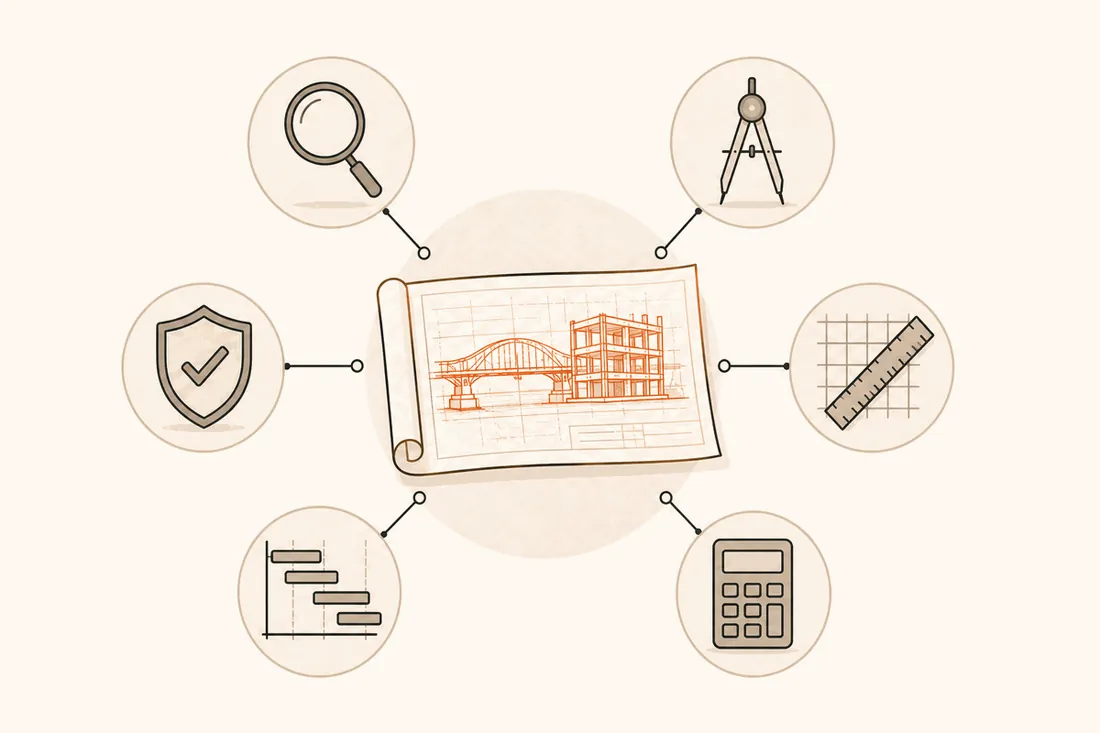
EPC vs item-rate — why it matters moreIn an item-rate contract the employer's BoQ caps the unknowns. In EPC/design-build, you carry the design and quantity risk, so the depth and accuracy of your pre-bid engineering is the single biggest lever on both winning and profitability.
Where EPC bids go wrong
- Pricing off guessed quantities instead of a real concept design — then bleeding margin in execution.
- Missing scope buried in the specs or ATC, discovered only after award.
- A technical proposal that's incomplete or off-format — rejected at the technical stage.
- Optimistic methodology/schedule that doesn't survive contact with the site.
- Not raising pre-bid queries, so ambiguities stay as un-priced risk.

A BidEasy / InfraLens service
We engineer winning EPC bids
Bidding an EPC or design-build tender and stretched on engineering bandwidth? Our team does the pre-bid heavy lifting — so you submit a compliant, sharply-priced, low-risk bid on time.
- Concept design & Design Basis Report
- Quantity take-off from drawings
- BoQ build-up & rate analysis
- Construction methodology & schedule
- Technical proposal & compliance matrix
- Eligibility mapping & pre-bid queries
Frequently asked questions
What is pre-bid engineering?
The engineering work done before submitting a bid — tender and site study, concept design, quantity take-off, BoQ and rate analysis, methodology, and the technical proposal — that lets a contractor submit a compliant, accurately-priced EPC bid.
Why does EPC need more pre-bid engineering than item-rate tenders?
In EPC / design-build the contractor owns the design, so you must engineer the solution enough to quantify and price it. Item-rate tenders give you a ready BoQ and ask only for rates.
What is a Design Basis Report (DBR)?
A document setting out the design assumptions, codes, loads and parameters behind your concept design — the technical foundation an evaluator checks and your quantities rest on.
What is quantity take-off?
Measuring quantities of work from the design — division by division (civil, structural, MEP) — so the BoQ and price reflect what will actually be built rather than a guess.
Can you help with our EPC bid?
Yes. We provide end-to-end pre-bid engineering — concept design, quantity take-off, BoQ and rate analysis, methodology, and the technical proposal. Get in touch with the tender details and timeline.